Domain Name system
An application on the Internet that translates domain names to IP addresses and vice-versa. In simple words, The Domain Name System (DNS) is a directory lookup service that provides a mapping between the name of a host on the Internet and its numerical internet address. DNS is comprised of 4 elements:
Resource Record
The DNS database is a collection of resource record organized into a distributed database. It contains the information like IP address, name servers for this domain name.
Name Servers
Name Servers are server programs that hold information about a portion of the domain-name tree structure and the associated RRs.
Resolvers
Resolvers are programs that extract information from name servers in response to client request. A typical client request is for an IP address corresponding to a given domain name.
Domain Name System Security Extensions (DNSSEC)
It is used by several protocols that provide e-mail security. It provides end-to-end protection through the use of digital signature. DNSSEC protects DNS clients from accepting forged DNS RRs. It protects these clients by using Digital Signatures to provide: Data origin authentication to ensure that a RR has originated from the content of a RR has not been modified. Data Integrity verification to ensure that the content of a RR has not been modified.
DNS Root Servers
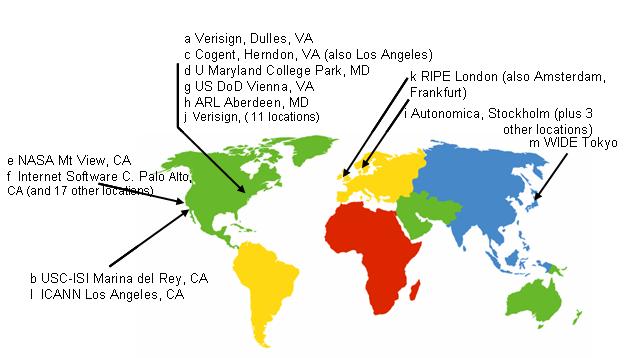
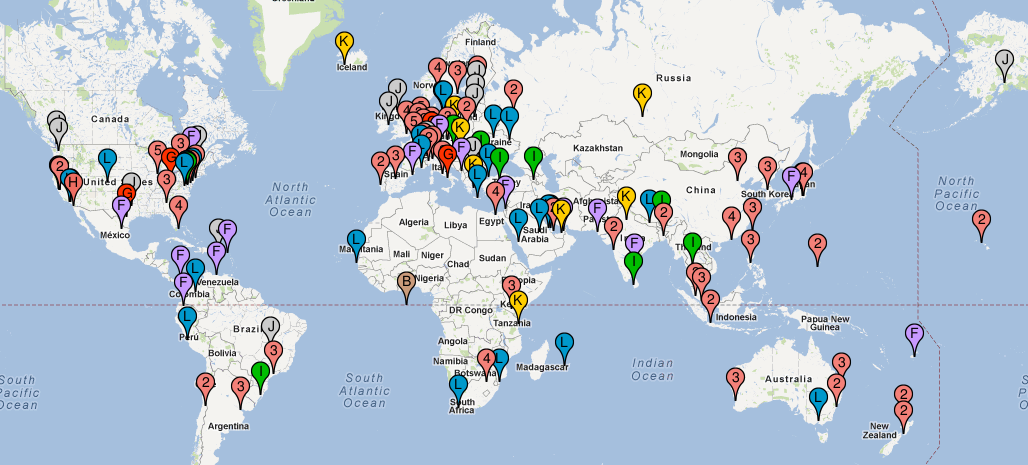
Root Zone File is published by 13 root servers named A to M, operated by various operators; 13 because of logical limitations – max packet size in UDP in 512 bytes; Replicated; 374 instances of same are available Each root server is a copy and none of them are special than others; so the number 13 is only notional India has replicas of 3 root servers; I root at Mumbai, K root at Delhi, and F root at Chennai
Root Zone file
Root name server uses this file (200 KB) to respond to queries, Contains names and IP addresses of authoritative DNS servers for all TLDs, ccTLD. Any changes to root zone file is requested by ICANN and then approved by Department of Commerce. US Department of Commerce has full authority; while ICANN is the root zone operator and Verisign is the root zone maintainer. ICANN is a public-benefit non-profit organization responsible for coordination of the Internet’s Global Domain Name System.
Locations of root servers
Replicas of root servers
Attacks on DNS
Fast Flux Botnet Attacks
In DNS pharming attacker hacks into the DNS server and changes the IP address for www.xyz.com to IP of www.xyz1.com (Fake page). So if the user enters the URL in address bar, the computer queries the DNS server for the IP address of www.xyz.com. Since the DNS server has already been poisoned by the attacker, it returns the IP address of www.xyz1.com (fake page).
DNS Pharming / Cache Poisoning
In DNS pharming attacker hacks into the DNS server and changes the IP address for www.xyz.com to IP of www.xyz1.com (Fake page). So if the user enters the URL in address bar, the computer queries the DNS server for the IP address of www.xyz.com. Since the DNS server has already been poisoned by the attacker, it returns the IP address of www.xyz1.com (fake page).
DNSSEC uses Public Key Cryptography and digital signatures to provide: Data Origin Authentication-Did the DNS reply really come from the .com zone? Data Integrity-Did an attacker modify the data in the response, since it was signed? So, it provides protection against (corruption) spoofing of DNS Data.